
When people enter a foreign environment, it may be overwhelming. Right when they get there, two questions form in their heads – where am I and where can I go? Wayfinding design is focused on these two questions to avoid confusion before it emerges.
By combining graphic design, architecture, and psychology, spm design environmental wayfinding design solves the problem of getting lost in a physical space. The main challenge of such a task is to find the right balance between aesthetics and utility, and only specialists can handle this challenge to create an attractive environment that effectively guides people.
The Four Core Elements of Spatial Navigation
Wayfinding does not suggest putting up signs. It is a complicated system that comprises different signals. There are four groups of signals in wayfinding design.
- Identification signals: Indicate specific places like entrances, rooms, or some landmarks.
- Directional signals: Make people go in the right direction and reach their destination.
- Informational signals: Provide overall data about a place (e.g., working hours, maps, and security procedures).
- Regulatory signals: Inform about significant rules and limitations connected with the place.
A successful system integrates all four sign types seamlessly into the existing architecture.
Why Form and Function Must Coexist
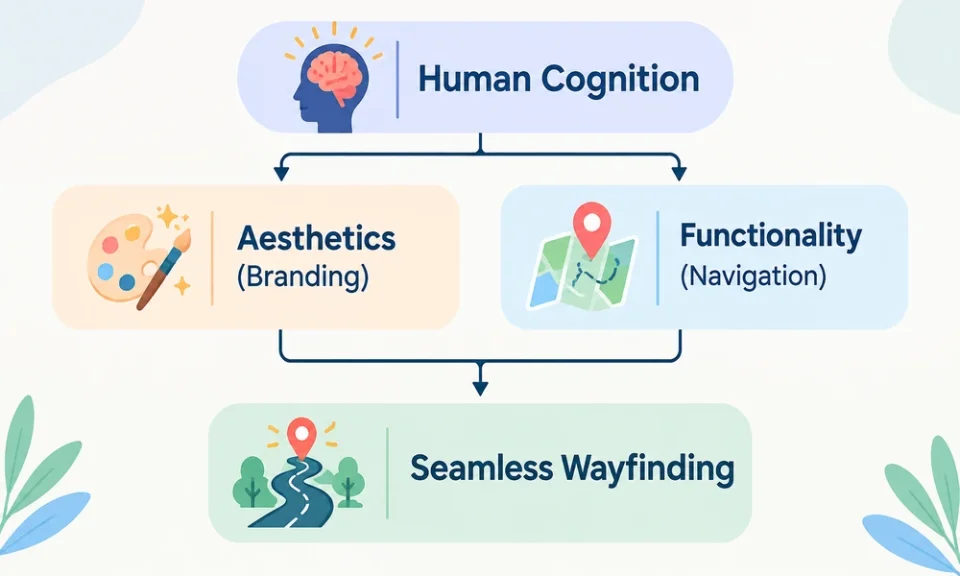
Designers frequently make the mistake of emphasizing either aesthetics or utilitarianism too much. While a system that is appealing to the eye may have futuristic, sleek signs that blend in seamlessly with their surroundings, rendering them useless in the event people get lost, a highly practical system can challenge visitors’ comfort with its excessive simplicity and dullness.
| Design Approach | Primary Focus | Common Pitfall |
|---|---|---|
| Aesthetics-Heavy | Visual harmony, brand identity, architectural minimalism | Poor legibility, hidden signage, directional confusion |
| Utility-Heavy | Maximum visibility, high contrast, strict standardization | Visual clutter, sterile feel, disruption of architecture |
| Balanced System | Intuitive guidance, contextual integration, clear branding | Requires upfront spatial research and custom strategy |
The true form of success takes place when the elements of wayfinding match the essence of the brand but remain readable.
The Psychology Behind Spatial Orientation
People build a representation of their surroundings in their mind, which is also called “cognitive mapping“. Once architectural spaces become complicated, people depend on clear environmental cues to maintain their sense of orientation.
It has been proven that a clear environmental design significantly decreases visitors’ anxiety levels and the number of spatial orientation mistakes. To facilitate mental mapping, designers use three main tools from psychology:
- Progressive disclosure: giving information to visitors only at the moment they need it in order to avoid information overload on entering a site.
- Visual hierarchy: the use of colors, sizes of typeface, and contrasts to make important messages prominent.
- Landmark points: the introduction of specific physical elements like sculptures, living walls, or some special lighting that become reference points.
Using a methodological approach from professionals in spm design environmental wayfinding design, companies can transform confusing layouts into simple and intuitive guide systems.
Key Strategies for Modern Wayfinding Systems
Creating a good wayfinding system presupposes analyzing existing pedestrian movement before making decisions about the typeface to use.
- Assess Key Locations: Find all the crowded places in the building where people tend to linger.
- Standardize Fonts and Symbols: Ensure that the graphics and text are highly readable regardless of age group.
- Combine Static and Digital Elements: Use physical wayfinding signs along with interactive digital kiosks or navigation applications.
- Ensure Universal Accessibility: Follow ADA requirements in relation to the height of installed elements, use of tactile lettering and Braille, and contrast of the materials.
Elevating Built Environments Through Navigation
Wayfinding design combines art and science. This system is so good that people do not even notice its presence-they simply follow it.
By achieving a proper balance between good looks and high-level efficiency, modern buildings become safer and more hospitable.
